
How Visual Consistency Builds Brand Trust in Ecommerce

How Visual Consistency Builds Brand Trust in Ecommerce
Shoppers can see products when browsing the online catalog, but not in detail. This means that all visual elements should build trust on the website. Based on Stanford research, 75% of consumers evaluate the credibility of a company based on its website design in a matter of seconds, without reading any content. Here's why visual consistency fosters trust (from the psychology of first impression to the dos and don'ts in product photography and brand guides).
Why Trust Is Everything in Ecommerce
Trust is the paramount challenge in online retail. In contrast to brick-and-mortar shops in which customers can see the quality of a product for themselves, ecommerce buyers must place all their trust in digital images and the reputation of the brand. These dynamics make brand trust in ecommerce not merely important but essential for conversion. A customer who doubts a store's legitimacy will abandon their cart regardless of price, selection, or convenience.
Since there is no touch involved, buyers have to take their own eyes for a spin. Product images, site design, and visual merchandising all act as stand-ins for the tactile assessment of products you would get in the brick and mortar environment.
Conversely, inconsistent or amateur visuals raise questions that damage conversion:
- Will the delivered item match the online representation?
- Is this a legitimate business or a temporary operation?
- Can customer service be trusted if problems arise?
Visual consistency functions as a signal of brand trust in ecommerce precisely because it requires investment and intentionality. Random or haphazard display implies a business that is slovenly, operates without systems, or is too under-resourced to uphold standards. Regular presentation reflects organization's competence and respect for the customer experience. So consumers’ logical takeaway becomes simple: If a brand can keep up strict visual standards, it is probably keeping up similar standards with its product quality and customer service.
What Is Visual Consistency (for Ecommerce)
Visual consistency is the result of applying the same or similar design elements within an interface or across multiple interfaces consistently. This includes any situation where a customer is interacting with the brand, like website pages, product listings, email communications, social media, advertising, and even packaging. The goal extends beyond aesthetic appeal to create a recognizable, repeatable visual system that customers identify instantly – the foundation of lasting ecommerce brand trust.
The foundational components of visual consistency span multiple design dimensions that work together to create a cohesive brand presentation:
- Color palette. A defined set of primary and secondary colors applied throughout all materials with exact specifications for digital and print usage;
- Photography style. Standardized lighting approaches, angles, backgrounds, and editing parameters applied uniformly to all product images;
- Typography. Consistent brand visuals fonts for headings, body text, and calls-to-action with clear hierarchy rules;
- Composition rules. Guidelines governing how elements are arranged within pages and graphics to ensure predictable layouts;
- Interface patterns. Standardized buttons, forms, navigation elements, and interactive components that look and behave identically throughout the customer journey;
- Packaging design. Physical materials that extend the visual system into tangible brand experiences.
Visual consistency differs from simply having a pretty website. Many attractive stores fail to convert because each page feels disconnected from the others. Strong visual branding in ecommerce means systematic repeatability — every touchpoint reinforcing the same identity rather than individual elements looking good in isolation.
Psychological Foundation – Why Repetition Builds Trust
The connection of visual repetition to influence and trust is well established in cognitive psychology. The human brain has evolved to be efficient, and it tends to process familiar stimuli rather than novel stimuli, because familiar information takes less processing. This taste preference translates into quantifiable outcomes, ultimately influencing consumer behaviors and perceptions toward the brand.
Psychologists call it the fluency effect – when information is easy to process, people trust it more. This applies to everything, from readable fonts to familiar faces. Consistent ecommerce branding works the same way: predictable colors, layouts, and imagery reduce mental effort, making your store feel reliable without customers knowing why.
Consider the typical customer journey. A visitor encounters your store for the first time and browses several products. Consistent photo styles, layouts, and color accents allow their brain to process information efficiently without conscious effort. They leave without purchasing, as most first-time visitors do.
Later, they encounter your advertisement on social media featuring the same visual identity ecommerce style. Recognition activates automatically. An email arrives with identical colors and typography. Each touchpoint requires less cognitive effort because the visual language is already familiar.
The table below shows some brand elements and their influence on customer trust:
Key Brand Elements and Their Impact on Customer Trust
Consistent branding plays a critical role in how users perceive and trust a website. When visual and functional elements remain predictable across all pages, users form mental shortcuts that make interactions faster and more comfortable.
Logo placement should remain in the same position and size throughout the entire website. This consistency allows users to instantly recognize the brand, reinforcing familiarity and credibility from the first glance.
CTA buttons must use identical colors, shapes, and hover states across all sections. When calls to action behave predictably, users experience less decision friction and feel more confident interacting with the site.
Product cards benefit from a uniform layout, consistent image ratios, and a clear information hierarchy. This structure enables users to scan and compare content efficiently, improving the overall browsing experience.
Typography should follow a consistent system of fonts and text sizes for headings, body text, and UI elements. A coherent typographic style enhances readability and contributes to a professional, trustworthy perception of the brand.
Color accents need to be applied using the same palette for highlights and interactive elements. Repeating accent colors strengthens brand memory and creates a cohesive visual identity.
Navigation structure should remain predictable in both organization and behavior. When menus work the same way across the site, users spend less mental effort understanding the interface, resulting in reduced cognitive load and higher trust.
When these elements remain consistent, customers build mental shortcuts that accelerate recognition and online brand trust. The brand becomes familiar even before purchase occurs, creating preference that competitors without systematic consistency cannot easily replicate.
Brand Recognition & Memory – How Consistency Makes You Memorable
Recognition precedes preference in consumer decision-making. Customers cannot choose a brand they do not remember, and visual consistency creates the memory anchors necessary for recall. This relationship between consistent presentation and memorability has significant implications for ecommerce brands competing in crowded markets.
When multiple stores sell identical products, visual style becomes the differentiator. Strong brand recognition online turns price shoppers into loyal customers who choose you because your look matches their taste – not just because you're the cheapest.
Major retailers demonstrate this principle through rigorous visual standards:
- IKEA. Maintains bright, airy lighting across all product photography with consistent blue and yellow palette applications throughout stores, catalogs, websites, and applications;
- Apple. Uses clean white backgrounds, minimal props, and precise angles that reinforce brand promises of simplicity and premium quality;
- Zara. Applies editorial-style photography with specific mood and color grading that remains constant across all channels and materials.
Consistent visuals turn one-time buyers into repeat customers. People start browsing your store not for specific items but because they trust your taste and standards. This ecommerce user trust builds until your aesthetic becomes inseparable from product quality in their minds.
This transformation requires sustained consistency across months and years of customer interactions. Brands that frequently redesign or allow visual standards to drift sacrifice accumulated recognition in exchange for temporary novelty. The most effective approach balances evolution with continuity, allowing gradual refinement while maintaining core visual elements that customers recognize and trust.

Product Imagery and Photography Style
Product photography carries exceptional weight in ecommerce conversion. Images often serve as the deciding factor between completed purchases and abandoned carts. The consistency of photography style across a product catalog directly impacts brand credibility online, customer trust, confidence, and purchasing behavior.
Effective product photography consistency encompasses multiple technical and aesthetic dimensions:
- Angles. Uniform perspectives across the catalog enabling easy product comparison;
- Lighting. Standardized illumination that flatters products while maintaining color accuracy;
- Backgrounds. Consistent product imagery, whether white, neutral, or contextual, applied throughout;
- Editing parameters. Specified color correction, contrast levels, and retouching approaches;
- Composition. Products positioned similarly within frames creating visual rhythm across pages;
- Props and styling. Consistent approach to accessory items and contextual elements.
These standards collectively ensure that every product image appears to belong to the same family, reinforcing brand coherence and quality perception. Consistent product photos eliminates these doubts by signaling uniform quality throughout the product range. The measurable business impacts include:
- Reduced return rates when delivered products match visual expectations
- Lower pre-purchase hesitation enabling faster conversion decisions
- Higher average order values as customers browse more extensively with less friction
- Stronger brand recall improving repeat purchase rates
- Decreased customer service inquiries about product specifications
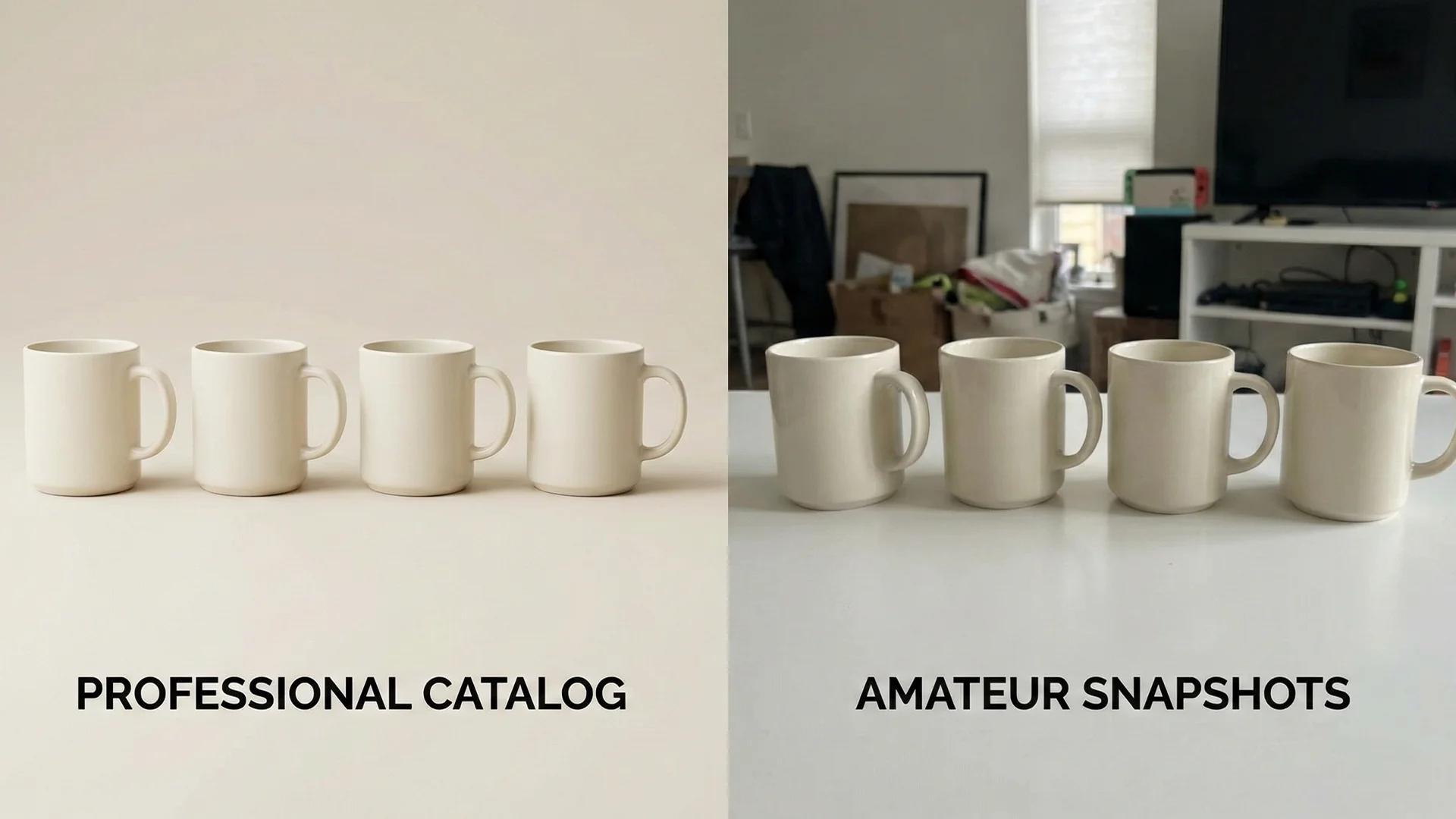
When you have seen the same product request both professional studio-quality photos and amateur shots on smartphones, customers notice — even if they don't realize they do. They wonder if you’re drop-shipping, skimping, or selling a flaky product. A unified visual brand identity eliminates these doubts before they cost you the sale.
Brand Style Guidelines – The Tool to Maintain Trust
The conformity will erode, such as all different participants coming to their own interpretation of what the brand means to them unless there is a clearly documented standard and a mechanism to enforce it. Brand style guidelines provide the framework necessary to maintain visual coherence across teams, vendors, and time periods.
Visual rules and guidelines are written in comprehensive brand guidelines – a series of reference documents that should be made available to all who will be producing brand materials. Some key documentation elements are:
- Color specifications with exact hex codes, RGB values, and Pantone matches.
- Typography sections naming fonts with detailed usage instructions for different contexts.
- Product photography standards providing example images alongside technical specifications.
- Logo usage rules covering sizing, spacing, and prohibited modifications.
- Layout templates for common applications including web pages, emails, and advertisements.
- Voice and tone guidance ensuring verbal messaging matches visual presentation.
Creating effective ecommerce product images requires clear standards that everyone follows. Without documented guidelines, each photographer or team member makes independent decisions about lighting, angles, backgrounds, and editing.
The results look inconsistent even when individual photos turn out well. A proper style guide eliminates guesswork and ensures every product shot reinforces your brand rather than contradicting it. For product photography specifically, guidelines should address:
- Lighting setup. Define equipment, positioning, and intensity to maintain product image consistency across every shoot.
- Shadow parameters. Specify direction, softness, and density so all images feel cohesive.
- Background standards. Document color, texture, and preparation requirements for unified presentation.
- Camera specifications. Set angles, distances, and lens choices that support trust psychology through predictable product displays.
- Retouching guidelines. Detail what to adjust and what to preserve for authentic yet polished results.
- File conventions. Create naming and sizing requirements optimized for different platforms.
- Color correction. Establish white balance and color grading standards that build customer trust online with accurate representation.
Documentation means nothing without enforcement. Smart brands assign someone to review every image, graphic, and marketing asset before it goes live. Photos that miss the mark get rejected or sent back for revision. This gatekeeping protects fluency effect branding – customers process consistent visuals faster and trust them more.
The review process catches problems that slip past individual creators. A photographer might nail the lighting but miss the background spec. A designer might use the wrong shade of brand blue. These small inconsistencies add up and chip away at your recognizable brand style. One person checking everything against the guidelines prevents the drift before customers ever notice.
Final Thoughts
Visual consistency drives growth, not just good looks. Matching colors, uniform product photos, and repeated design patterns shape brand perception online in ways customers feel but can't explain. The payoff is real: higher conversions, fewer abandoned carts, lower return rates, and buyers who come back. Every consistent element compounds the last.
Yes, brand guidelines and quality photography require upfront investment. But competitors who dismiss this as superficial hand you an easy advantage. When shoppers land on a trustworthy online store, they sense it immediately – and that feeling converts better than any discount code.
